
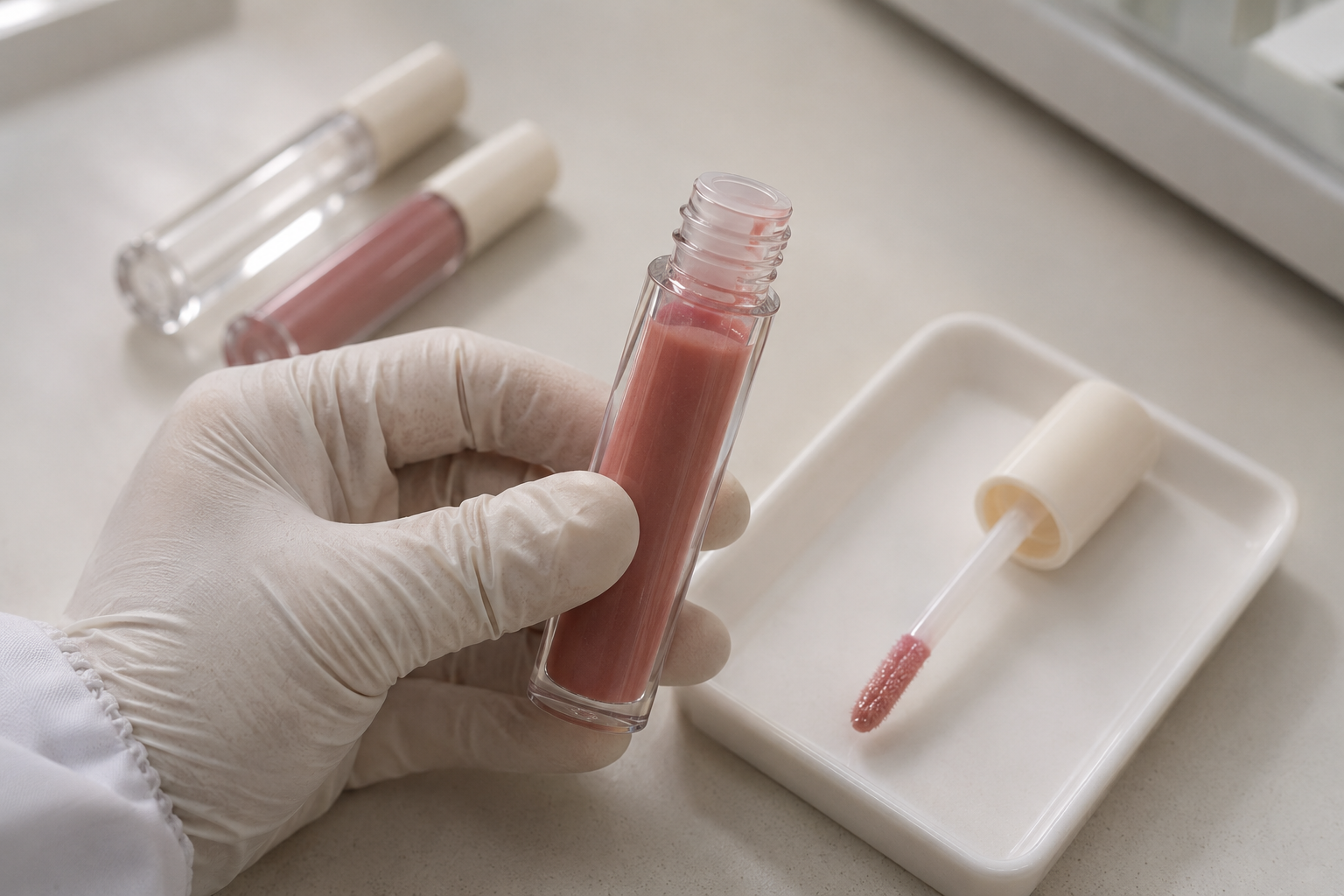
A lip gloss sample can look perfect on your desk and still arrive with sticky threads, stained cartons, or product inside the cap. Lip Gloss Tubes may leak because of mismatched components, poor sealing contact, incorrect filling levels, inconsistent capping, or formula incompatibility. The difficult part is identifying which problem you actually have before thousands of units are filled. These seven checks help you trace the leak, test the complete package, and turn sample approval into clear production requirements.
1. Trace Where Your Lip Gloss Tubes Start Leaking
Product around the neck does not automatically mean the bottle is defective. It could be filling residue, gloss transferred during applicator withdrawal, or leakage from a closed package.
Start with freshly filled samples. Clean the exterior, photograph the neck, and store separate units upright, sideways, and inverted under agreed conditions. Inspect them before opening: unscrewing the cap can spread residue and hide the original leak path.
| What you observe | What to investigate first |
|---|---|
| Gloss appears immediately after filling | Nozzle drips, overfilling, contaminated neck |
| Product escapes from a closed cap | Sealing contact, closure alignment, torque |
| Gloss collects after repeated use | Wiper fit, applicator loading, product buildup |
| Leakage appears after warm storage | Formula changes, expansion, component deformation |
| Only scattered units leak | Dimensional variation or assembly inconsistency |
Treat these as starting points, not final diagnoses. Change one variable at a time so you can identify what actually fixes the problem.
2. Check the Seal Before Tightening Lip Gloss Tube Caps
A cap can feel tight without creating an effective seal. Threads pull the closure into position; the design’s sealing surfaces must make the intended contact.
Ask your supplier to identify exactly where the package seals. Depending on the design, this may involve the bottle neck, wiper flange, or a feature inside the closure.
Inspect samples for:
- Uneven neck rims, moulding flash, or damaged threads.
- Caps sitting crooked or stopping before sealing contact.
- Wipers that sit above their intended position.
- Gloss trapped on sealing surfaces during filling.
Do not assume extra tightening will solve leakage. Excessive force can distort components or damage threads. Confirm that the bottle, cap, stem, and wiper belong to the approved assembly, especially when replacing an applicator or mixing similar-looking components.
3. Test the Lip Gloss Wiper Through Repeated Use
The wiper controls how much product remains on the applicator. Its fit also affects neck cleanliness and, in some designs, sealing performance.
A loose insert may move during withdrawal. An overly restrictive opening can make the wand difficult to remove. An unsuitable wiper-and-stem combination may leave excess gloss where the cap closes.
Test the complete applicator with your actual formula. During repeated opening and closing, record:
- Whether the insert lifts, rotates, or becomes displaced.
- Whether withdrawal force changes.
- How much product accumulates around the neck.
- Whether the closed package leaks after use.
Keep unopened samples as a comparison. If only repeatedly used samples leak, investigate buildup and component movement before changing the bottle material.
4. Confirm Lip Gloss Tube Fill Levels With the Wand Installed
A container’s brimful capacity is not its usable fill volume. The stem and applicator occupy space, and inserting them raises the product level.
A tube that looks comfortably filled before assembly may overflow when the wand enters.
Run a filling trial using the intended nozzle, formula temperature, wiper installation sequence, and closure. Test the target fill and the upper end of your permitted filling variation.
Check for product displacement into the neck, trapped air, and contamination of sealing surfaces. If filling by weight, establish the corresponding volume using the formula’s density at the relevant temperature.
Agree on usable capacity for the assembled package. There is no universal headspace percentage that suits every lip gloss formula and tube design.
5. Measure Lip Gloss Cap Torque on the Filling Line
Hand-closed samples can pass while production-filled units leak because the capper applies inconsistent force.
Define an application torque range with the packaging supplier and filler. Then measure removal torque after an agreed rest period and after relevant conditioning. Opening torque should not be assumed to equal the original tightening torque.
Use pilot-line samples to check whether:
- Caps engage straight without cross-threading.
- Capping heads deliver consistent results.
- Closures loosen during storage or transit simulation.
- Consumers can open the package comfortably.
Torque, compatibility, environmental conditioning, and leakage testing address different aspects of package performance; passing one does not replace the others.
A leak-free result achieved only through unusually aggressive tightening is a reason to review the assembly.
6. Test Lip Gloss Packaging Compatibility Beyond Day One
An empty lip gloss tube cannot establish compatibility with a finished formula. Water-filled checks may reveal gross defects, but they cannot reproduce every formula’s flow or interaction with packaging materials.
Use the final formula and production-intent components. Include all product-contact parts, particularly the wiper and applicator.
Agree on storage conditions and inspection intervals with your formulation team or testing laboratory. Compare conditioned samples with room-temperature controls, checking for:
- Swelling, softening, cracking, or deformation.
- Changes in wiper retention and closure operation.
- Formula separation or changes in flow.
- New leakage or unexplained weight changes.
Weight loss alone does not prove leakage; evaporation and other causes need investigation. Likewise, a short warm-storage test does not establish a full shelf life.
Reassess compatibility when the formula or a relevant component changes.
7. Make Lip Gloss Tubes Pass a Pilot Run and Shipping Trial
A carefully assembled sample does not demonstrate that thousands of units will behave consistently.
Use a pilot run to evaluate the intended components, filling equipment, and assembly process together. Include samples from different mould cavities and production stages where traceability allows.
Test filled units in the actual shipping configuration. Select temperature exposure, vibration, drops, and—where relevant—reduced-pressure testing around your distribution route. Inspect both immediately afterward and following a defined rest period.
Before approving wholesale lip gloss tubes, document:
- The approved component specifications and reference samples.
- Fill limits and capping settings.
- Test conditions, duration, sample quantities, and acceptance criteria.
- Who investigates failures and authorises corrective action.
Tengyi Beauty supplies custom empty cosmetic packaging, including lip gloss tubes. When discussing samples, share your intended formula type, fill quantity, applicator requirements, and shipping conditions. Your formulation or filling partner should validate the final formula-package combination before bulk filling.
FAQs: Practical Questions About Leaking Lip Gloss Tubes
Why does my lip gloss leak even when the cap is tight?
The cap may reach its mechanical stop without making proper sealing contact. Check alignment, sealing surfaces, wiper seating, and component matching before increasing torque.
Can overfilling cause lip gloss tubes to leak?
Yes. Inserting the wand displaces product and can push gloss into the neck or onto sealing surfaces. Validate fill quantity with the complete assembly.
Does a lip gloss wiper prevent leaks?
Its main role is controlling product on the applicator. It may contribute to sealing, depending on the design, but cannot compensate for every closure or compatibility problem.
Can I use the same tube for lip gloss and lip oil?
Possibly, but test both formulas separately. Differences in flow and material compatibility can change performance even when the packaging is identical.
How long should I test lip gloss packaging before production?
There is no universal duration. Agree on a programme covering compatibility, repeated use, filling performance, and distribution conditions. A quick inversion check alone is insufficient.
Should I reject a batch if only a few samples leak?
Hold approval while investigating. Record the failure rate and trace affected components or filling settings. Apply your agreed sampling and acceptance plan, then verify the corrective action.