
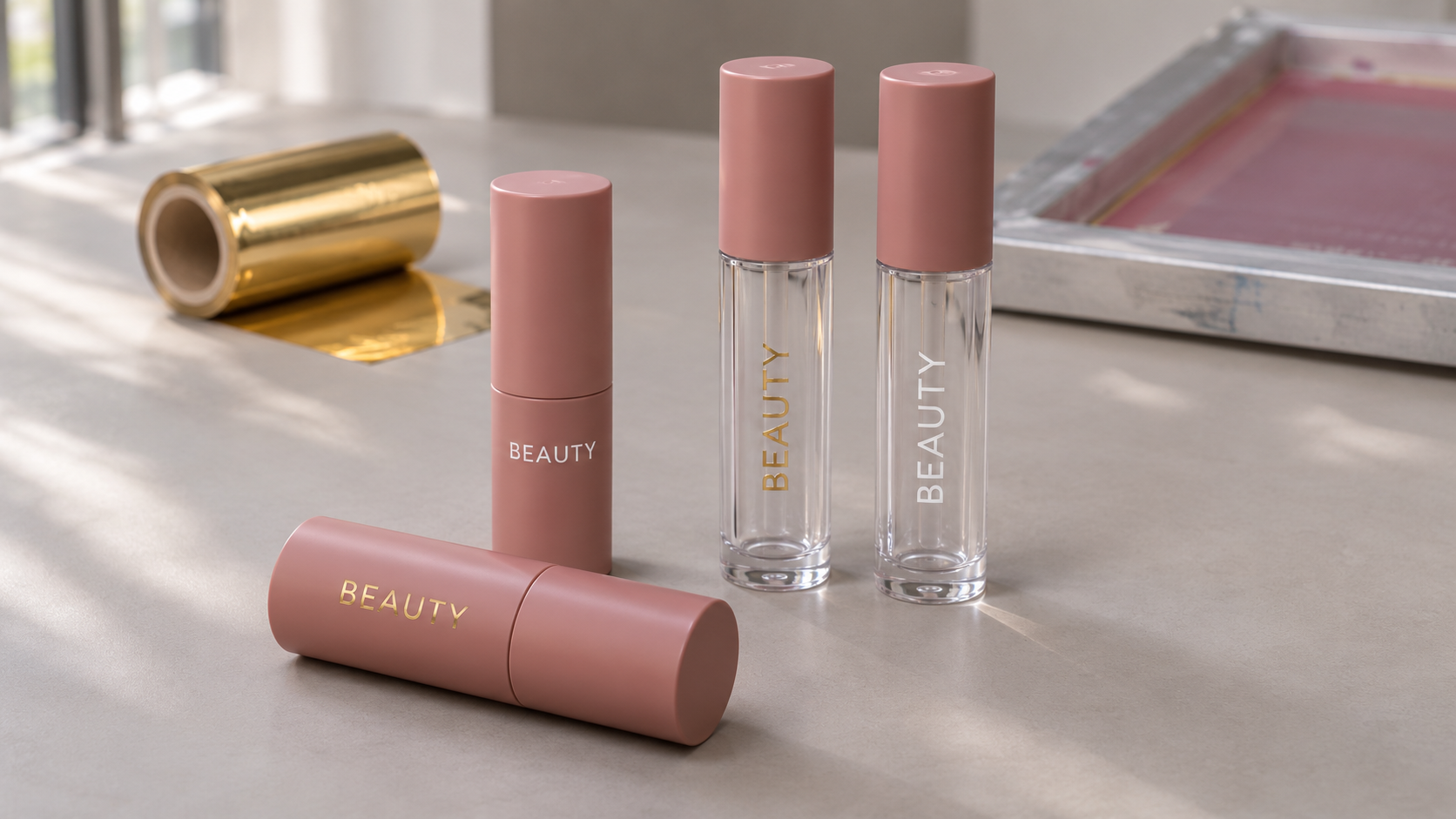
A logo can look perfect in a digital mockup yet lose clarity, colour or adhesion on the finished container. When comparing hot stamping vs silk screen printing for cosmetic packaging, consider more than the visual effect. This guide explains how each method affects appearance, durability, artwork and cost—and what to check before approving lipstick tubes, lip gloss tubes or powder compacts for production.
Hot Stamping vs Silk Screen Printing: What Will Your Customers Notice?
Hot stamping uses heat and pressure to transfer a decorative layer from a carrier foil onto a surface. Metallic gold and silver are familiar options, although pigment and other foil finishes are also available.
Silk screen printing, also called screen printing or silkscreen printing, pushes ink through a patterned mesh onto the component. The ink then dries or cures, depending on its formulation.
For buyers, the practical difference starts with how the decoration reflects light.
| Buying consideration | Hot stamping | Silk screen printing |
|---|---|---|
| Visual effect | Metallic foil can deliver a reflective, mirror-like finish | Solid colours; metallic inks offer a different effect |
| Common application | Highlighted logos, borders and decorative accents | Brand colours, logos and product text |
| Colour approval | Select and approve a physical foil reference | Approve a colour-matched print on the actual component |
| Main sampling concern | Incomplete transfer, broken edges or unwanted foil | Poor opacity, blurred details or inadequate curing |
| Durability | Depends on foil, surface and processing | Depends on ink, surface and drying or curing |
Choose the visual target first, then validate the process. Neither method automatically guarantees better quality.
Choose Hot Stamping When Your Logo Needs a Reflective Finish
For a gold logo on a lipstick cap, metallic hot foil stamping is a strong starting point when you want a bright reflection. Gold screen printing ink generally produces a different metallic appearance, so the two should not be treated as interchangeable.
Request physical samples and rotate them under diffuse and directional light. A foil logo that looks striking head-on may become harder to read at certain angles.
The printable shape also matters. A flat powder compact lid and a curved lip gloss tube require different tooling and contact conditions. KURZ describes both vertical and roller processes for decorating flat or curved plastic surfaces. Curvature alone does not rule out hot stamping, but it changes the production approach.
Before approval, ask:
Can the full logo transfer cleanly within the proposed decoration area?
Do fine lines remain continuous?
Are there visible pressure marks or surface distortion?
Does the chosen foil retain sufficient contrast against the packaging colour?
Choose Silk Screen Printing When Colour and Readability Come First
Screen printing on cosmetic packaging is worth evaluating for white logos on coloured lip gloss tubes, solid brand colours and supporting product text.
However, a Pantone reference alone does not define the finished result. The container colour, transparency, surface finish and ink opacity influence what customers see.
For example, white lettering on transparent PETG should be reviewed against both light and dark backgrounds—and with the intended filled appearance considered. A print that looks opaque on a white inspection table may appear weaker in use.
Ask the supplier to show:
The proposed ink on the actual component and finish.
The smallest text at its final size.
Colour consistency across several samples.
Registration where multiple colours meet.
For small lettering, avoid assuming screen printing always beats foil stamping. Both require artwork suited to the equipment and surface. Approve a production-size sample, not an enlarged PDF.
Avoid Peeling Logos by Testing Hot Stamping and Screen Printing on the Final Surface
“Can you print on PP?” is only the first question. The more useful question is: “Can this decoration adhere to this exact component, with this surface finish?”
A bare moulded surface and a coated surface are different printing substrates. A successful trial on unfinished plastic does not establish performance after spraying or another finish.
Marabu’s technical guidance illustrates this distinction: one packaging ink system specifies pretreatment for PP and calls for preliminary trials even within the same plastic type. PETG processing conditions can also affect surface behaviour.
When comparing hot stamping durability vs screen printing, request separate checks for:
| Check | What it helps reveal |
|---|---|
| Agreed adhesion test | Decoration lifting from the surface |
| Controlled rub test | Wear, colour transfer or loss of detail |
| Relevant formula-contact test | Damage after foreseeable contact with the cosmetic formula |
| Packing and transport simulation | Scuffing caused by adjacent parts or packing materials |
Define the test conditions, timing and acceptance criteria before testing. “Passed 100 rubs” is difficult to interpret without knowing the load, rubbing material and whether the test was wet or dry.
Decoration testing also does not replace compatibility testing between the formula and the container.
Keep Fine Logos Sharp with a Hot Stamping or Screen Printing Artwork Check
Artwork problems often become visible only after decoration: thin strokes disappear, small letter openings close, or a logo approaches a curved shoulder too closely.
Before making tooling or screens, send vector artwork and request confirmation of:
Minimum line width and minimum gaps between elements.
Smallest acceptable text for the selected font.
Decoration boundaries and clearance from edges.
Position tolerance relative to seams, hinges or cap features.
There is no universal minimum font size that works for every cosmetic container. Letter shape, surface geometry and process capability all matter.
If the design fails, first consider slightly thicker strokes, wider spacing or moving the logo onto a more consistent surface. These adjustments may preserve the design without changing the entire packaging concept.
Compare Hot Stamping vs Screen Printing Costs Using the Same Specification
Hot stamping is not always more expensive, and screen printing is not always the budget option.
Compare quotations using the same component, quantity, artwork dimensions, decoration positions and quality requirements.
Total decoration cost includes setup, production passes, handling, inspection and rejects—not just foil or ink.
Ask suppliers to separate:
Tooling or screen charges.
Decoration cost per piece.
Extra colours and printing positions.
Surface preparation, if required.
Sampling and artwork revision charges.
Also confirm whether the MOQ applies per container colour, decoration design or SKU. Splitting an order across several artworks can change the economics even when the total quantity stays the same.
Approve Your Cosmetic Packaging Printing with a Clear Sample Checklist
Before releasing a bulk order, retain an approved physical sample and record:
Component material, colour and surface finish.
Foil reference or approved ink colour.
Artwork version, dimensions and position.
Acceptable appearance and placement variation.
Agreed adhesion, abrasion and formula-contact results.
Packing method that protects decorated surfaces.
You can combine foil stamping and screen printing—for example, a metallic logo with solid-colour supporting text. However, confirm the process sequence and test any overlapping layers; compatibility cannot be assumed.
For a Tengyi Beauty packaging enquiry, provide your selected container, vector logo, desired finish, order quantity and intended formula-contact conditions. These details help narrow the decoration options and make the first sample more useful.