
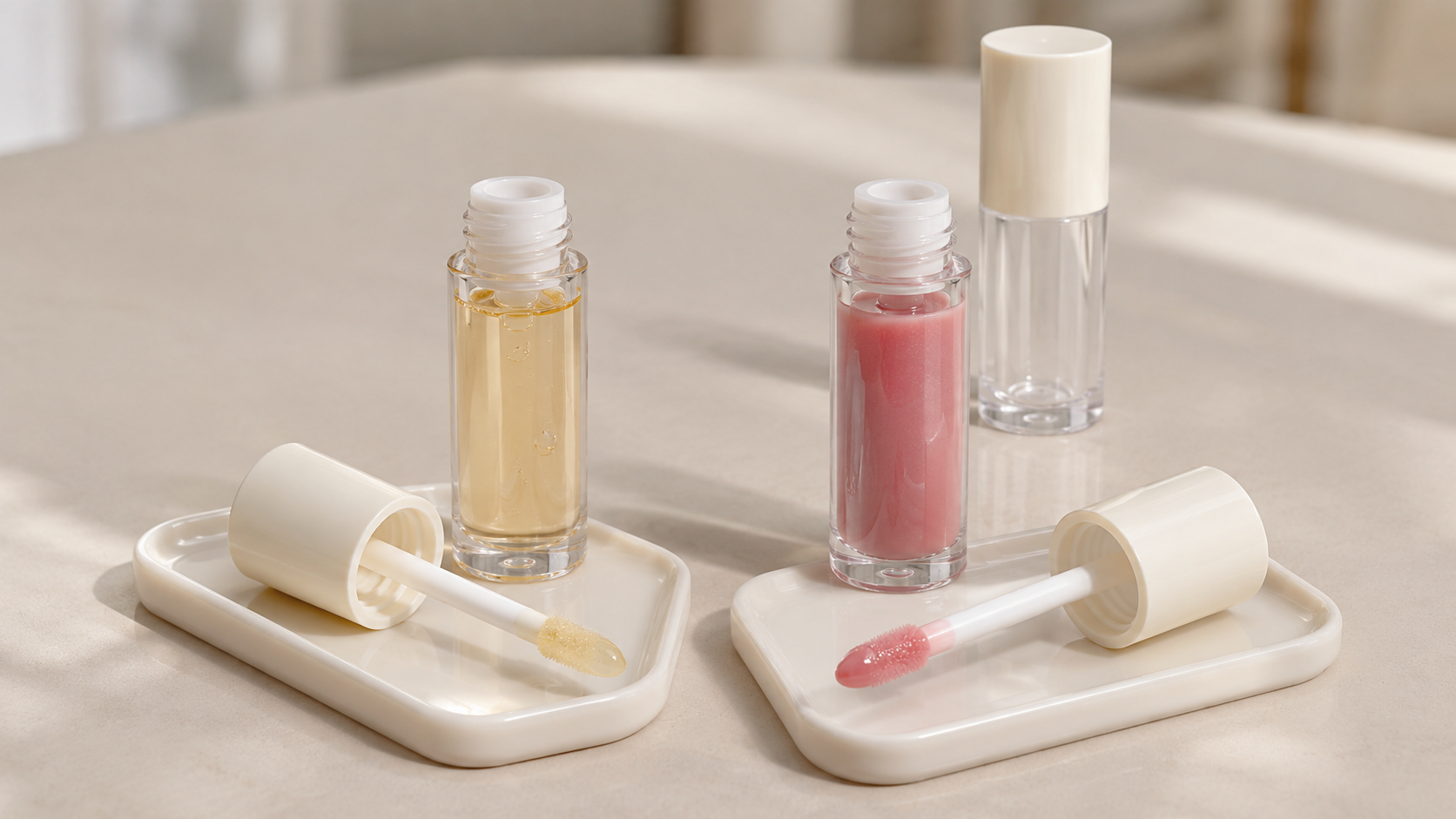
Yes, lip oil and lip gloss can use the same packaging—but only when both formulas pass testing in the complete pack. Lip Gloss Tubes that work beautifully with a thick gloss may deliver too much product, develop messy necks, or leak with a more fluid oil. For brands launching both products, the opportunity is to share a packaging design while checking whether the wiper, applicator, materials, and closure need different specifications.
Choosing Lip Gloss Tubes Starts with Formula Behaviour
“Lip oil” and “lip gloss” describe product categories, not fixed viscosities. Some oils are thickened into gels; some glosses are lightweight and highly fluid. Choosing Lip Gloss Tubes by product name alone can therefore lead to the wrong component combination.
Ask your formula manufacturer how the product flows at room temperature and under anticipated storage conditions. Then compare these practical requirements:
| What to compare | More fluid formula | Thicker formula |
|---|---|---|
| Applicator loading | Watch for dripping and excessive pickup | Watch for uneven loading and stringing |
| Wiping | Remove excess without leaving the tip underloaded | Allow enough product through for comfortable application |
| Neck cleanliness | Check for oil collecting around the opening | Check for buildup after repeated use |
| Product retrieval | Assess drainage and dosing consistency | Assess product remaining on walls and near the base |
| Closure performance | Check seepage during storage and transport | Check leakage and contamination of sealing surfaces |
These are starting points for evaluating Lip Gloss Tubes, not rules that every formula follows.
A useful purchasing question: “Can we test both formulas in this exact bottle, wiper, wand, and cap combination?”
Lip Gloss Tubes Feel Different When the Wiper Changes
The wiper is the insert inside the bottle opening that removes excess product from the applicator. Its geometry and flexibility influence how much formula reaches the lips and how smoothly the wand pulls out. The wiping system is a key part of application performance.
For Lip Gloss Tubes intended for lip oil, do not automatically request the smallest wiper opening. Overly aggressive wiping can leave too little product on the tip or make withdrawal uncomfortable.
Instead, compare sample combinations and record:
Whether the applicator drips after withdrawal.
How many dips are needed for the intended coverage.
Whether product accumulates on the stem or bottle neck.
Whether the wiper stays firmly seated after repeated opening.
A larger doe-foot applicator also needs checking against the opening. Changing the brush without reviewing the wiper can alter both dosing and pull-out force.
Treat the applicator and wiper as a matched pair when specifying Lip Gloss Tubes.
Lip Gloss Tubes Need More Than a Tight Cap to Prevent Leaks
A cap that feels tight does not prove the package seals correctly. Threads bring components together; sealing depends on the pack’s actual contact surfaces and component fit.
When Lip Gloss Tubes leak, identify where the formula first appears:
| Visible symptom | What to investigate |
|---|---|
| Product outside the closed cap | Sealing surfaces, closure fit, applied torque |
| Oil around the wiper | Wiper seating, retention, and neck fit |
| Mess immediately after wand insertion | Fill level, displacement, and product on the stem |
| Leakage after repeated use | Wear, contamination, or components loosening |
Avoid trying to solve every leak by tightening harder. Excessive torque can damage components or make the product difficult to open.
Evaluate Lip Gloss Tubes upright, sideways, and inverted under an agreed test protocol. Include repeatedly opened samples: an untouched pack and a consumer-used pack may behave differently.
Clear Lip Gloss Tubes Still Need Material Compatibility Testing
A clear bottle makes colour and fill level easy to see, but appearance cannot establish formula compatibility. PETG Lip Gloss Tubes should not be approved simply because another oil-based product used PETG successfully.
Request the material specification for every formula-contact component: bottle, wiper, stem, applicator, and any relevant sealing parts. For flocked applicators, include the flocking and adhesive system.
Assess Lip Gloss Tubes for changes such as cracking, distortion, swelling, discolouration, odour, or altered application performance. The formula itself also needs monitoring.
Industry laboratory practice includes compatibility, application, wiping, and weight-loss tests on filled packaging—supporting evaluation of the complete system rather than the bottle alone.
Approval applies to the tested formula and component specification. A formula reformulation or component substitution should trigger a review of whether retesting is needed.
Filling Lip Gloss Tubes to the Advertised Capacity Can Backfire
Before ordering empty lip gloss tubes, ask whether the quoted capacity means brimful capacity or a recommended working fill.
The applicator and stem occupy space inside the bottle. Lip Gloss Tubes filled too high may overflow during assembly or push product into the neck when the wand is reinserted.
Check three things with your filling partner:
Target net content: If filling by weight, use the actual formula density to establish the required volume.
Assembled fill level: Evaluate the pack with its production wand and wiper installed.
Filling process: Confirm how dispensing accuracy and component assembly affect cleanliness.
Use the intended filling method when trialling Lip Gloss Tubes. Hand-filled samples can help with early screening, but they do not establish production-line performance.
Testing Lip Gloss Tubes Before Ordering Saves More Than Unit Cost
Use this checklist to plan sample approval with your packaging supplier and formula manufacturer. Agree on sample quantities, conditions, duration, and acceptance criteria before testing.
| Check | What to record |
|---|---|
| Initial assembly | Fill weight, component codes, closing torque |
| Storage in different orientations | Leakage location, exterior residue, weight change |
| Temperature exposure | Changes to formula, pack shape, sealing, and dosing |
| Repeated opening and closing | Wiper retention, neck buildup, closure performance |
| Application trial | Pickup consistency, dripping, comfort, number of dips |
| Transport simulation | Leakage, damage, and component loosening |
| Near-empty use | Product access and remaining unusable formula |
Do not approve Lip Gloss Tubes because one sample survives an overnight inversion test. That is an early screen, not evidence of shelf-life performance.
Keep an approved reference sample and written component specifications. When purchasing wholesale Lip Gloss Tubes, require suppliers to communicate changes to materials or functional components before implementation.
Sharing Lip Gloss Tubes Works Best When You Define What Stays the Same
There are three practical outcomes:
Share the complete pack: Both formulas pass in the identical component combination.
Share the appearance: Keep the bottle and cap design, but use separately validated applicator or wiper options.
Use separate packaging: Material, sealing, or dosing requirements cannot be met reliably by one design.
The second option can preserve a coordinated collection, provided the supplier confirms component compatibility and availability. Remember that separate internal components also require clear identification during purchasing and assembly.
For brands exploring custom Lip Gloss Tubes, Tengyi Beauty is a starting point for discussing existing designs, colour, and logo customisation. Include your formula samples, target fill, and preferred application feel in the enquiry so functional suitability can be assessed alongside appearance.
Choose shared Lip Gloss Tubes when testing supports the decision—not simply because the products look similar in the bottle.