
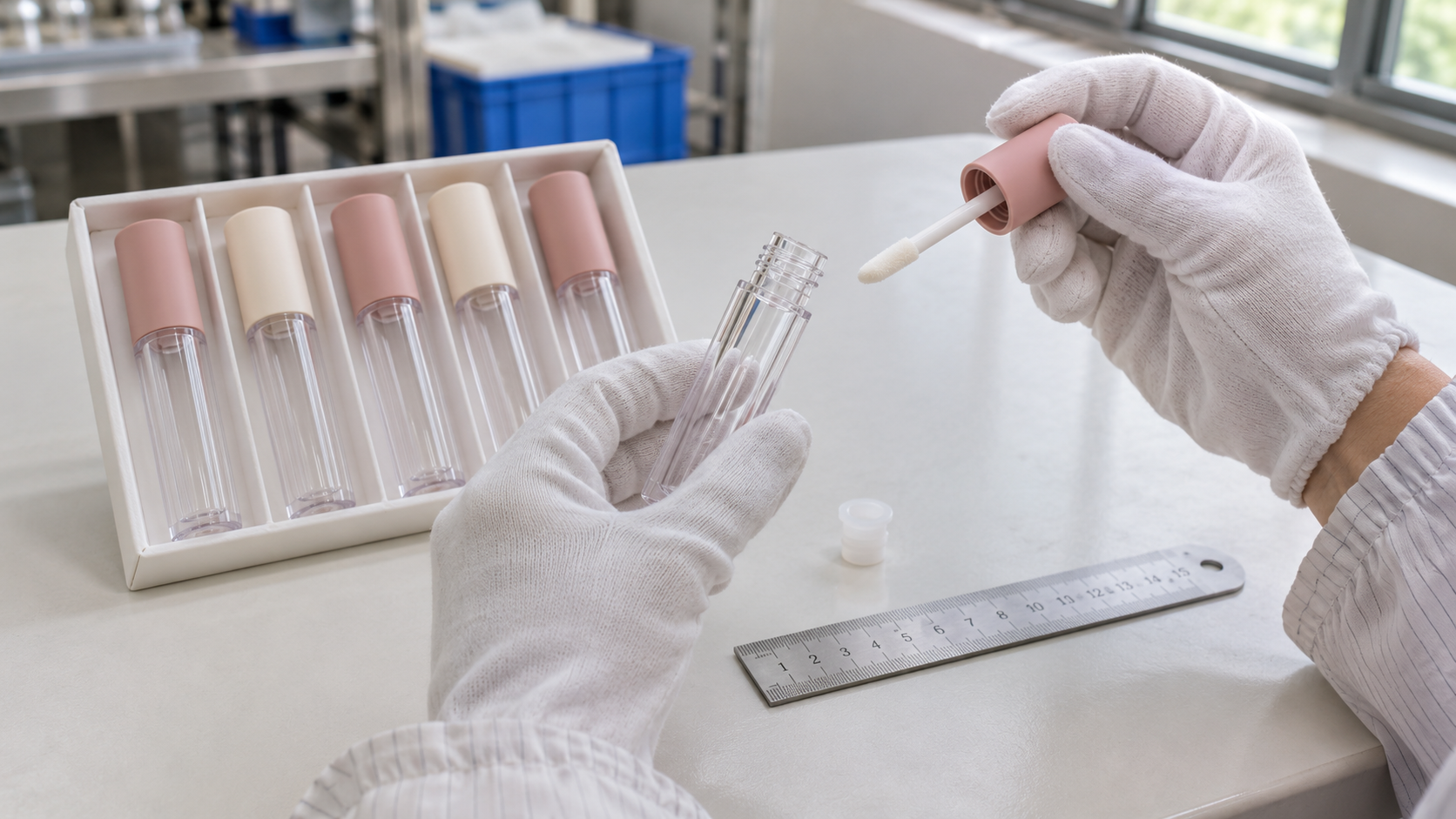
Ordering wholesale lip gloss tubes can look straightforward until samples leak, applicators pick up too much formula, or the final invoice includes components you assumed were included. Attractive packaging matters, but reliable performance depends on how the bottle, wiper, wand and formula work together. Before choosing a custom lip gloss tubes manufacturer, use these seven checks to evaluate samples, compare quotations and approve production with fewer surprises.
1. Check Whether Lip Gloss Tubes Suit Your Actual Formula
A packaging sample that works with one gloss may behave differently with another. Formula viscosity, oils, fragrances and storage conditions can affect material compatibility and dispensing performance.
Test lip gloss tubes with your intended formula—not water or a supplier’s demonstration liquid. Request material specifications for every formula-contact component, including the bottle, wiper, stem and applicator.
Have your formulation team define suitable test conditions and inspection intervals. Record changes against freshly filled control samples:
Cracking, clouding, swelling or discolouration.
Changes in formula appearance, odour or texture.
Wiper loosening or changes in insertion resistance.
Leakage, weight loss or residue around the neck.
Ask before ordering: “Which materials contact our formula, and can those specifications be fixed for bulk production?”
A material name alone does not establish compatibility. Approve lip gloss tubes based on testing the complete filled assembly.
2. Test Lip Gloss Tubes for Leakage Beyond an Upright Desk Test
A tightly closed cap does not automatically mean a reliable seal. Leakage can involve the bottle neck, sealing surfaces, wiper seating or assembly variation.
Evaluate filled lip gloss tubes upright, sideways and inverted under conditions agreed with your filling partner. Include repeated opening and closing, since a package may behave differently after formula accumulates around the neck.
For a useful comparison:
Fill samples to the intended commercial quantity.
Clean the exterior and record starting weights.
Close each sample using a defined, repeatable method.
Inspect after storage and appropriate transport simulation.
Record where residue appears and whether weight changes.
Check the neck after withdrawing the wand: residue deposited during use can resemble leakage.
Ask before ordering: “What closure and leak-test conditions will we approve together?”
Avoid choosing lip gloss tubes based solely on one unfilled sample that feels secure.
3. Try Lip Gloss Tubes with the Complete Wand-and-Wiper Assembly
The applicator influences how the product feels, but the wiper controls how much formula reaches it. An oversized doe-foot can still deliver an inconsistent application if the opening removes too much—or too little—product.
Compare lip gloss tubes using the same formula and fill level. Evaluate the first withdrawal, repeated use and performance as the bottle empties.
| What you notice | What to investigate |
|---|---|
| Applicator comes out overloaded | Wiper opening, flexibility and formula viscosity |
| Applicator feels almost dry | Excessive wiping or unsuitable applicator geometry |
| Formula collects around the neck | Wiper seating and withdrawal behaviour |
| Wand is difficult to remove | Wiper resistance and applicator dimensions |
| Product remains difficult to reach | Wand length and internal bottle geometry |
Where useful, weigh several applicator withdrawals to compare pickup consistency.
Ask before ordering: “Can we test alternative wipers or applicators before approving these lip gloss tubes?”
An attractive brush shape should earn approval through application tests.
4. Confirm What “5 ml Lip Gloss Tubes” Actually Means
A stated capacity can refer to nominal fill volume or capacity measured close to the brim. These are different specifications.
The wand and applicator displace formula when inserted. Filling lip gloss tubes too high can cause overflow, neck contamination or closing problems.
Ask for the recommended working fill and brimful capacity separately. Then have your filling partner verify:
Target net content with the actual formula.
Headspace after wand insertion.
Filling-nozzle access and bottle stability.
Compatibility with handling and capping equipment.
If you sell by weight, do not assume 5 ml equals 5 g. Conversion depends on formula density.
Also check external dimensions. Two lip gloss tubes with the same advertised capacity may require different cartons, inserts and filling-line settings.
Ask before ordering: “What usable fill quantity has been verified with the assembled wand?”
5. Approve Decorated Lip Gloss Tubes, Not Just Colour Renderings
A digital mock-up cannot show how a logo behaves on a curved surface or how a finish responds to handling.
Request decorated lip gloss tubes made using the intended production process. Injection colour, spray coating, silk-screen printing and hot stamping can produce different visual and durability results.
Inspect the sample under consistent lighting. Check logo position, small-text clarity, colour coverage and alignment when the cap is closed. If rotational logo alignment matters, confirm feasibility before committing to the design.
Agree on suitable adhesion, rubbing and formula-contact checks for the decoration. Define acceptable variation against a physical reference sample.
For brand-specific lip gloss tubes, Tengyi Beauty is a supplier to contact with your preferred shape, formula requirements, colour reference and artwork. Request a project-specific quotation and physical samples to assess the proposed customisation.
Ask before ordering: “Will the approved decoration sample represent the materials and processes used for production?”
6. Compare Lip Gloss Tubes by Complete Order Cost
A low unit price means little if quotations cover different components or services.
When comparing wholesale lip gloss tubes, confirm whether the price includes the bottle, cap, wand, applicator and wiper. Separate component costs from printing, tooling, sampling, protective packing and freight.
Clarify minimum quantities per colour, design and decoration option. A total order of 12,000 units does not necessarily allow three colours of 4,000 each.
| Quote item | Detail to confirm |
|---|---|
| Complete assembly | Every included component |
| Customisation | Colours, print positions and setup charges |
| Samples | Stock versus customised sample fees |
| Packaging | Dividers, bags, trays and carton quantities |
| Delivery | Shipping terms and excluded charges |
Compare landed cost per usable unit using the same assumptions. Cheaper lip gloss tubes can become expensive if they require extra handling or arrive inadequately protected.
7. Lock Lip Gloss Tubes Specifications Before Paying the Deposit
A good sample is useful only when the purchase order clearly defines what bulk production must match.
Create an approval record for your lip gloss tubes containing component specifications, dimensions, colour references, artwork, decoration placement and an identified reference sample. Retain matching approved samples with both parties.
Agree on inspection methods and defect handling before production. Distinguish functional failures, such as leakage or detached wipers, from cosmetic variation. Specify inspection sampling and acceptance criteria rather than relying on “standard quality.”
Confirm when the production lead time starts and how component substitutions or specification changes require approval.
Before releasing the order, collect:
Approved filled-performance and decorated samples.
A complete quotation and component specification.
Written inspection and defect-resolution terms.
A production schedule tied to clear approval milestones.
These records make lip gloss tubes easier to reorder consistently—and give both sides a practical reference if the shipment differs from what was approved.